
Table of Content
Quick Answer: Luxury candle packaging is a specification problem before it is a design problem. Pick the build for how the candle is actually bought, measure the vessel properly, budget for an insert and spend your finishing money on one decision rather than three.
Two candle boxes can carry the same logo, the same colour and the same print file and one of them will still feel like a $14 candle while the other feels like a $48 one. The difference is almost never the artwork. It is board, fit and finish, decided weeks before anyone opens a design file.
Most brands find this out late. They approve a beautiful flat design, receive a carton that flexes when the jar goes in and spend the next production run fixing something that started as a specification problem.
This guide covers what separates luxury candle boxes from ordinary ones in physical terms: which build to choose, what size your box actually needs to be, why inserts matter more than foil and what genuinely moves the price. Everything here is the same reasoning we use when we spec a box for a client.
What "luxury" means in candle packaging
Strip away the marketing and a premium box is doing three physical jobs. Customers register all three in about four seconds, mostly without noticing they are doing it.
Structure: it holds its shape under the hand
Cheap packaging gives. Press the side panel of a thin folding carton and it dents; the dent stays. A heavier caliper board, or a rigid box wrapped over greyboard, resists that pressure and springs back. This is the single biggest driver of perceived value, and it is decided entirely by board choice.
Surface: light behaves differently on it
Gloss lamination bounces light evenly, which reads as retail. Soft-touch lamination absorbs it and feels slightly warm and powdery under the fingers, which reads as premium. Uncoated and kraft surfaces read as craft or natural. None is better in the abstract. The mistake is choosing one because it looks good on a screen, where all three look identical.
Fit: the candle does not move
A jar that rattles undoes everything else. A candle that lifts out with slight resistance, then settles back into its seat, is the part people remember and cannot articulate. That is a function of internal dimensions and inserts, not print.
Get those three right and you can print in one colour and still look expensive. Get them wrong and no amount of gold foil rescues it.
Rigid, folding carton or kraft: choosing the build
Almost every luxury candle box lands in one of three builds. The right answer depends on your price point, your shipping model and your order volume.
| Build | Feels like | Best for | Watch out for |
|---|---|---|---|
|
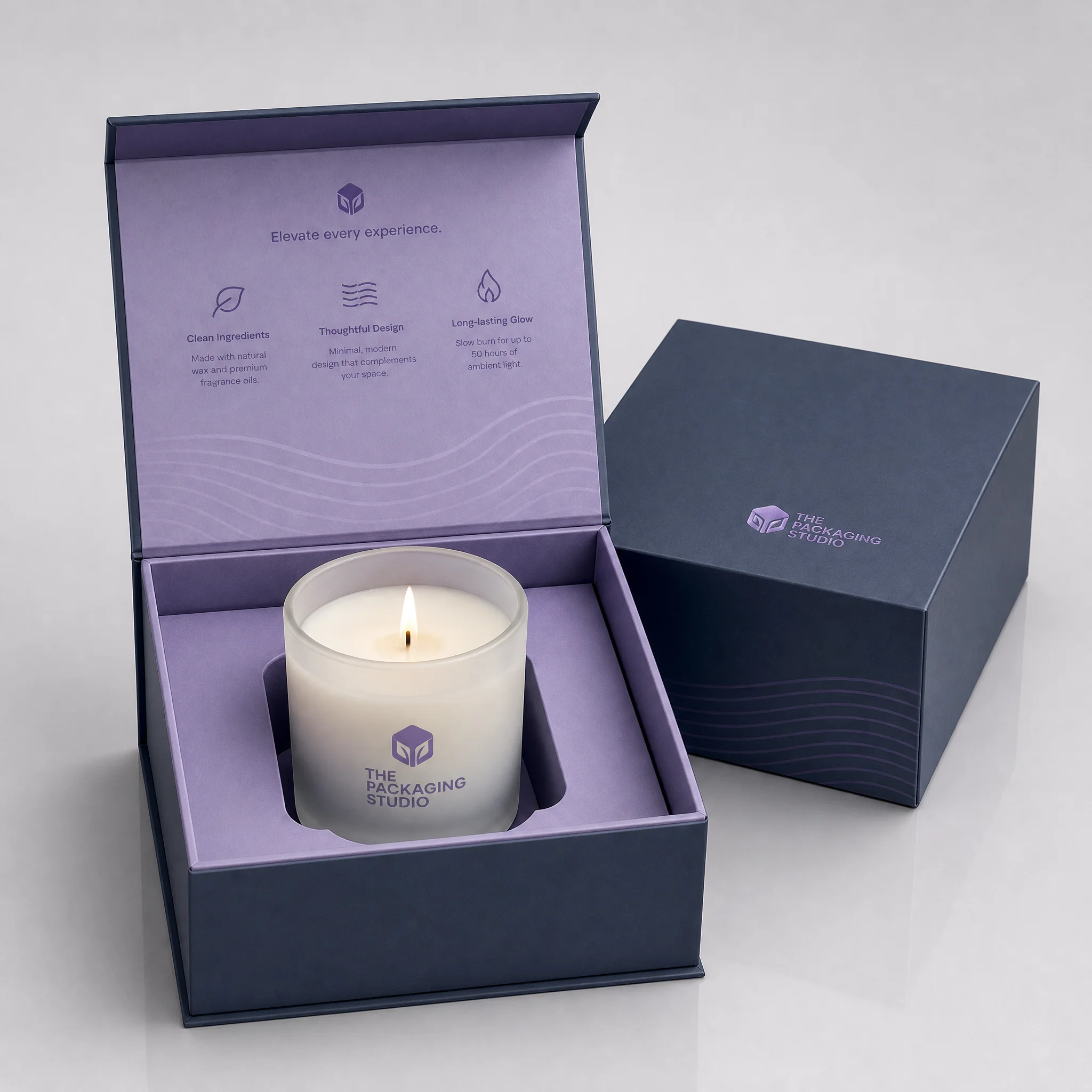
Rigid (setup) box |
Dense, ceremonial, opens slowly
|
$40+ candles, gift sets, wedding and corporate favours |
Highest unit cost; ships flat only with a collapsible design |
|
Folding carton |
Clean, retail-ready, light |
$18–$40 candles, shelf and boutique retail, subscription |
Needs adequate caliper board or it flexes around glass |
|
Kraft / natural carton |
Honest, tactile, eco-forward |
Botanical, apothecary and refill-led brands |
Print colours shift against a brown substrate; test before you commit |
A practical rule: if your candle is sold as a gift more often than it is sold to the person burning it, rigid earns its cost back. If it sits on a shelf next to competitors, a well-specified folding carton with a strong surface finish usually wins on cost per impression.
Rigid candle boxes also change how the product opens. A lid that lifts with a slight vacuum resistance is a designed effect, not an accident, and it comes from tolerance between lid and base measured in fractions of a millimetre.
Getting the size right before anything else
More reprints are caused by wrong internal dimensions than by anything in the artwork. Measure your actual vessel, including the lid and any label bulge, then add clearance for the insert.
These are common starting dimensions for US candle formats. Treat them as a reference point, then confirm against your specific vessel and production tolerances.
| Candle format | Box size (L × W × H, inches) |
|---|---|
|
4 oz tin |
3.00 × 3.00 × 2.50 |
|
8 oz jar |
3.75 × 3.75 × 4.00 |
|
9 oz tumbler |
3.50 × 3.50 × 4.50 |
|
12 oz tumbler |
4.00 × 4.00 × 4.50 |
|
3 × 6 pillar |
3.25 × 3.25 × 6.25 |
|
Taper pair |
13.00 × 2.00 × 1.25 |
Two things people miss. First, height is usually the problem dimension, because lids and wick trimmers get added after the box is specified. Second, if you plan a two-candle or three-candle gift set later, decide the single-candle footprint now so the set is a clean multiple of it. Retrofitting a set around an odd single size costs you a whole new die.
Inserts, and why brands regret skipping them
If your candle ships direct to consumer rather than to a retailer, treat the insert as a shipping cost, not a design cost. It is cheaper than a replacement candle and a refund. An insert is the cheapest upgrade in candle packaging and the first thing cut from a budget. It should be the last. Glass is heavy and unforgiving. In transit, an unsupported 8 oz jar shifts inside its carton, scuffs the print from the inside, and arrives sounding hollow when the customer shakes the parcel. Both are avoidable.
Common options, roughly in order of cost:
- Corrugated partition or platform: cheapest, invisible, does the structural job. Fine when the box will not be opened as a gift.
- Die-cut card insert: a shaped seat the jar drops into. Good balance of cost and presentation.
- Foam insert: maximum protection and a soft, high-end seat. Worth it for heavy vessels and multi-candle sets.
- Moulded pulp: protective and recyclable, and increasingly the default for brands with a sustainability position.
If your candle ships direct to consumer rather than to a retailer, treat the insert as a shipping cost, not a design cost. It is cheaper than a replacement candle and a refund.
Finishes that read as premium (and ones that don't)
Finishing is where budgets get spent fastest and returns vary most.
Reliably premium:
- Soft-touch lamination: The highest perceived-value return per dollar in the whole category, because it changes how the box feels rather than how it looks.
- Foil stamping on a small mark: A restrained foil logo outperforms a large foil pattern almost every time.
- Emboss or deboss: Works especially well on uncoated and kraft stock, where there is no coating to flatten the relief.
- Spot UV over matte: A gloss element against a matte field creates contrast that a photo of the box cannot reproduce, which is exactly why it works in the hand.
Often wasted:
- Full-coverage gloss on a premium candle; it reads as mass retail.
- Foil across large areas, which magnifies any registration drift.
- Heavy dark solid ink coverage on kraft, where the brown substrate dulls the result. Print white first or reconsider the stock.
One principle covers most of it: on luxury candle boxes, one strong finishing decision beats three competing ones.
We keep things simple. All you need is a product and a vision. We will handle the rest. From custom box structures to premium finishes, our team works with you to create packaging that’s uniquely yours. No templates. No guesswork. Just your vision and our creative mind.
Of course. Our in-house brand designers can work with you to create a custom look that aligns with your brand identity.
We offer flexible MOQs depending on the packaging type - perfect for startups and scale-ups alike.
We are with you from concept to creation and beyond.
Yes, we offer prototypes and physical samples so you can review the design, fit and finish before full production.


